
The Naija Founder Story We Keep Repeating, and the Chapters It Hides

There is a version of the Nigerian founder story that has become the default in how we talk about Nigerian startups, and it goes something like this. A young Nigerian in Lagos or Ibadan sees a problem that everyone has accepted as unfixable, builds a clever technical solution against significant infrastructure constraints, raises money from a foreign investor who recognises the local knowledge as an asset, and eventually builds a company that either gets acquired or continues to grow into one of the notable Nigerian tech successes.
This story appears in nearly every profile of a Nigerian founder in the last decade, and it is not a wrong story, but it has become the only story, and the singularity of it hides most of what actually happens in Nigerian entrepreneurship.
The purpose of this piece is to name what the dominant story leaves out, so that founders reading it can see themselves in the wider set of stories that Nigerian entrepreneurship actually contains, and so that the culture around Nigerian startups can develop more honest expectations than the single narrative currently produces.
The chapter about the years before
The first thing the story leaves out is the years before the notable success. Every founder we celebrate has a decade of failed attempts, uncelebrated jobs, family tensions, and quiet years that never make it into the profile, and the omission of these years produces the false impression that the notable founders emerged fully formed.

Younger founders reading these profiles then wonder why they themselves have not emerged fully formed, and the answer is that no one does, but the story has erased the evidence of that fact and left them to feel uniquely behind.
If you are in the years before, know that you are not behind, you are just in a chapter that does not get written about. The years before are usually longer than the celebrated years, and they are where most of the actual formation of a founder happens, even though nobody profiles them.
The chapter about the founders who did not make it
The second thing the story leaves out is all the founders who did not make it.
For every notable Nigerian company you can name, there are dozens of founders who worked equally hard, made similar decisions, and did not have the same outcome.
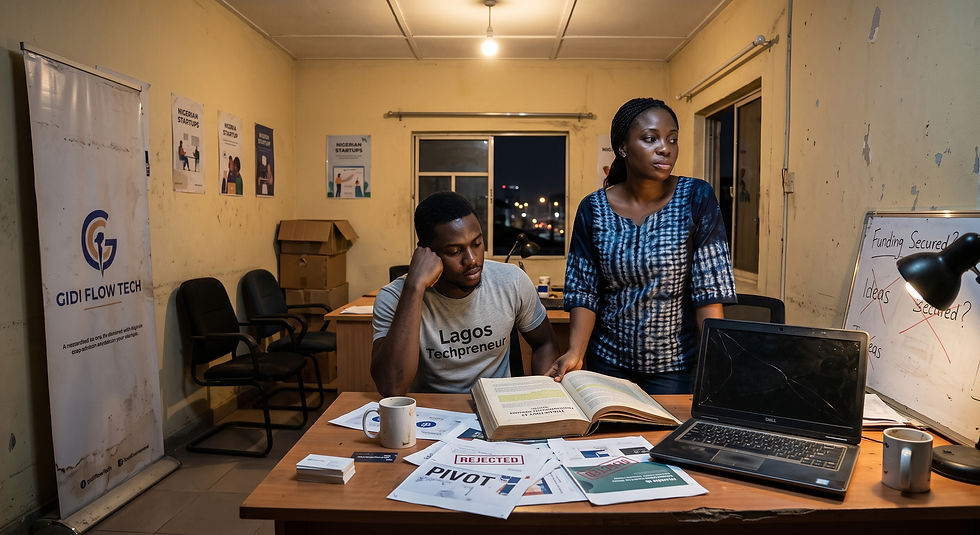
Some of them ran out of money at the wrong moment. Some of them had co-founders leave at the wrong moment.
Some of them chose markets that turned out to be smaller than they seemed. The particular reasons vary, but the pattern is that most Nigerian founders you never hear about were not less capable than the ones you did hear about, they were less fortunate, and the omission of this fact from the popular story makes it look as though outcome is entirely deserved rather than partly circumstantial.
If your own outcome is not matching the celebrated ones, that is not necessarily a signal that you are worse. It might be a signal that you are more like the many uncelebrated founders whose stories are just as real, and holding yourself to the standard of the outlier is not a fair standard to hold yourself to.
The chapter about the emotional cost
The third thing the story leaves out is the emotional cost of the celebrated founder journey.

Reading the profiles, you get the impression that the journey was mostly stressful in interesting ways, and that the founder emerged with a good story to tell. The reality is closer to a decade of chronic anxiety, damaged relationships, and mental health struggles that many of the celebrated founders have quietly disclosed in private but do not put in the profiles. The cost is real, and it does not disappear even for the founders who succeed, and pretending otherwise misleads younger founders about what they are actually signing up for.
If you are struggling with the emotional cost of the work, you are not weak or unusually fragile, you are having the response most founders have and hide. Take the cost seriously, protect what you can protect, and understand that the founders whose stories look easy from the outside are usually working much harder inside than the story admits.
What a more honest version would look like
A more honest version of the Nigerian founder story would include the years before, the founders who did not make it, and the emotional cost, alongside the celebrated moments. It would present entrepreneurship as a real thing that people do rather than a special calling for exceptional people, and it would leave more room for founders whose lives do not fit the dominant narrative. Whether the culture develops that version depends on whether we choose to tell the wider version when we write and speak about founders, and each of us has some small ability to influence the story by including the parts that usually get cut. It is worth being aware of the story we are all repeating, and being willing to include the chapters that make it more true even when they make it less exciting.


Comments